
Implementing an Efficient Wireless Temperature Monitoring System
What Is a Wireless Temperature Monitoring System?
A wireless temperature monitoring system remotely measures and tracks temperature data without physical cable connections, transmitting information through radio frequency signals to a central monitoring location. These systems eliminate the need for hardwired infrastructure while providing real-time temperature visibility across distributed environments.
The architecture relies on four essential components working in harmony:
- Temperature sensors: Devices that capture thermal readings from the environment or specific objects.
- Wireless communication modules: Components responsible for data transmission using radio protocols.
- Data acquisition units: Units that process and prepare sensor readings for transmission.
- Central monitoring platform: The system that receives, stores, and visualizes the collected information for analysis and decision-making.
Core Components of a Wireless Temperature Monitoring System
The sensor layer forms the foundation of data collection:
- Thermistors: Cost-effective resistive sensors offering high sensitivity in narrow temperature ranges, typically -50°C to 150°C
- RTDs (Resistance Temperature Detectors): Precision sensors using platinum elements for industrial applications requiring accuracy within ±0.1°C
- Semiconductor sensors: Integrated circuit-based devices providing digital output with built-in signal conditioning
Each sensor type connects to a microcontroller that converts analog temperature readings into digital signals. The microcontroller packages this data with timestamps and node identifiers before passing it to the wireless communication module.
The wireless communication layer enables cable-free data transfer across distances ranging from meters to kilometers depending on the protocol selected. Communication modules attach to sensor nodes and establish connections with gateways or receivers that bridge to the central platform.
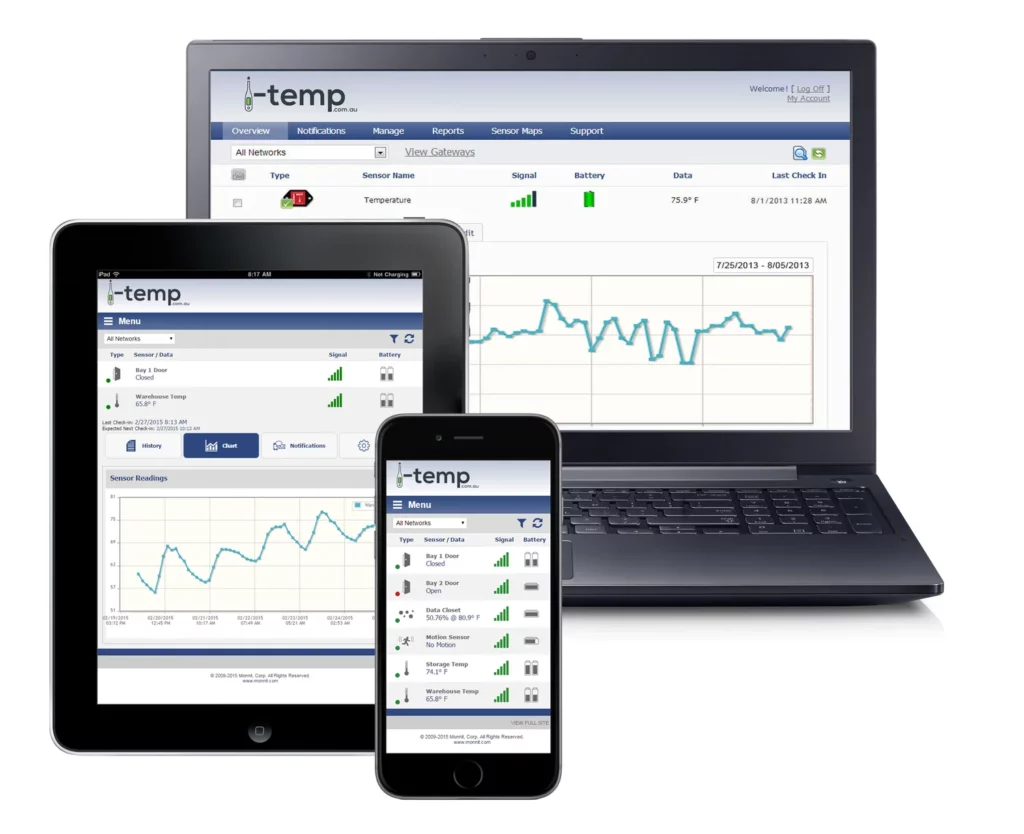
Central monitoring platforms aggregate data streams from multiple sensor nodes, presenting temperature trends through dashboards and triggering alerts when readings exceed defined thresholds. Cloud-based platforms extend accessibility, allowing stakeholders to monitor conditions from any internet-connected device.

How Do Wireless Temperature Monitoring Systems Transmit Data?
In a Wireless Temperature Monitoring System, data transmission begins at the sensor node, where microcontrollers process raw temperature readings before converting them into digital signals suitable for wireless transmission. These microcontrollers serve as the intelligence layer of the Wireless Temperature Monitoring System, handling analog-to-digital conversion, applying calibration algorithms, and packaging data into standardized formats that wireless communication protocols can interpret.
What Role Do Sensor Nodes Play in Data Processing?
Sensor nodes act as miniature computing units that bridge the gap between physical temperature measurements and digital communication. Each node contains a microcontroller that samples the temperature sensor at predetermined intervals, filters noise from the raw signal, and performs local data validation. This preprocessing reduces the amount of data requiring transmission and conserves battery power by eliminating unnecessary wireless activity.
Modern sensor nodes often incorporate edge computing capabilities, allowing them to make local decisions about when to transmit data. A node might only send updates when temperature changes exceed a specific threshold, or it can buffer multiple readings and transmit them in batches during scheduled intervals.
Which Wireless Communication Protocols Are Most Commonly Used?
ZigBee operates on the IEEE 802.15.4 standard and excels in applications requiring low power consumption and mesh networking capabilities. The protocol supports hundreds of nodes in a single network, with each device consuming minimal energy during operation. ZigBee networks self-heal by automatically rerouting data around failed nodes, making them ideal for industrial environments where reliability is paramount.
Wi-Fi provides high-speed data transmission and seamless integration with existing network infrastructure. Temperature monitoring systems using Wi-Fi can leverage standard routers and access points, simplifying deployment in buildings already equipped with wireless networks. The protocol supports real-time data streaming and can handle large volumes of information, though at the cost of higher power consumption compared to alternatives.
Bluetooth Low Energy (BLE) balances power efficiency with adequate data rates for temperature monitoring applications. BLE-enabled sensors can operate for years on coin-cell batteries while maintaining reliable connections within a 50-100 meter range. The protocol’s widespread adoption in smartphones and tablets enables direct monitoring through mobile applications without requiring dedicated gateway hardware.
Proprietary RF technologies offer customized solutions tailored to specific operational requirements. These systems operate on sub-GHz frequencies (typically 433 MHz
Why Is Efficient System Design Critical in Wireless Temperature Monitoring?
Efficient system design determines whether a wireless temperature monitoring system operates reliably for months or fails within weeks. The three pillars of efficiency—low power consumption, sensor calibration, and reliable communication—directly impact operational costs, data accuracy, and system longevity.
How Does Power Consumption Affect System Viability?
Battery-powered sensor nodes must operate for extended periods without maintenance, making power optimization essential. A poorly designed system draining batteries every few weeks creates unsustainable maintenance burdens and operational disruptions.
Sleep mode implementation represents the most effective power-saving strategy. Sensor nodes should remain in ultra-low-power sleep states between measurements, waking only to collect data and transmit readings. Modern microcontrollers consume as little as 0.5 microamperes in deep sleep mode compared to several milliamperes during active operation.
Duty cycling schedules determine measurement frequency based on application needs. Industrial freezers maintaining stable temperatures may only require readings every 15 minutes, while pharmaceutical storage might demand 5-minute intervals during critical processes. Reducing transmission frequency from every minute to every 10 minutes can extend battery life by 500-700%.
Adaptive transmission power adjusts signal strength based on distance to the gateway. Nodes positioned close to receivers waste energy broadcasting at maximum power, while distant nodes may require full strength. Dynamic power adjustment can reduce energy consumption by 30-40% across a network.
Energy harvesting technologies supplement or replace batteries entirely. Solar panels integrated with sensor nodes work effectively in greenhouse monitoring, while thermal energy harvesters capture temperature differentials in industrial pipe monitoring. Piezoelectric generators can power sensors in high-vibration environments.
Why Does Sensor Calibration Matter for Data Integrity?
Uncalibrated sensors produce measurements that drift over time, leading to false alarms, compliance failures, and flawed decision-making. A pharmaceutical cold storage system reporting 4°C when actual temperature reaches 6°C could result in product spoilage and regulatory violations.
Two-point calibration establishes accuracy across the operating range by measuring known reference temperatures at the low and high ends of the expected spectrum. Ice water (0°C) and boiling water (100°C) serve as reliable points for this calibration process.
Moreover, it’s important to note that the effectiveness of such system designs is not solely dependent on the aforementioned factors but also significantly influenced by the overall design strategy employed in the implementation of these systems.
What Are the Key Considerations When Implementing These Systems?
1. Sensor Selection
Sensor selection forms the foundation of implementing an efficient wireless temperature monitoring system. The choice between thermistors, RTDs, and semiconductor sensors depends on the specific temperature range, accuracy requirements, and environmental conditions of your application.
- Thermistors excel in applications requiring high sensitivity within limited temperature ranges (-50°C to 150°C), making them ideal for medical devices and consumer electronics.
- RTDs provide superior accuracy and stability across wider temperature spans (-200°C to 850°C), suited for industrial processes and laboratory equipment.
- Semiconductor sensors offer cost-effective solutions with built-in signal conditioning for moderate accuracy requirements in HVAC and automotive applications.
2. Environmental Factors
Environmental factors significantly influence sensor selection. Humidity, corrosive chemicals, electromagnetic interference, and physical vibrations can degrade sensor performance or cause premature failure.
- Sensors deployed in food processing facilities need food-grade enclosures and resistance to frequent washdowns.
- Industrial settings with high electromagnetic noise require shielded sensors with robust filtering.
- Outdoor agricultural monitoring demands weatherproof housings with UV resistance and wide operating temperature ranges.
3. Wireless Network Topology
Wireless network topology determines coverage reliability and system scalability. Star topology connects all sensor nodes directly to a central gateway, offering simple configuration and easy troubleshooting. This approach works well for small-scale deployments within 100 meters where line-of-sight communication exists. A single gateway failure, however, disables the entire network.
Mesh topology creates multiple communication paths between nodes, with each sensor capable of relaying data from neighboring devices. This self-healing architecture maintains connectivity even when individual nodes fail or obstacles block direct paths. Mesh networks scale effectively across large facilities, warehouses, or agricultural fields spanning several kilometers. The trade-off involves increased complexity in network management and higher power consumption from relay functions.
Hybrid topologies combine star and mesh elements to optimize specific deployment scenarios. Critical sensors maintain direct gateway connections while peripheral nodes form mesh sub-networks. This configuration balances reliability, coverage, and power efficiency for complex industrial environments with varying communication requirements.
4. Power Management Solutions
Power management solutions extend operational lifespan and reduce maintenance costs. Battery-powered sensor nodes typically consume 10-50 mA during active transmission and 1-10 µA in sleep mode. Implementing duty cycling—where sensors wake periodically to measure an
Where Are Wireless Temperature Monitoring Systems Applied?
Wireless temperature monitoring systems serve critical functions across diverse industries, each with unique requirements and regulatory demands. These systems provide real-time data collection, automated alerts, and comprehensive documentation that traditional manual monitoring cannot match.
Industrial Monitoring Applications
Industrial monitoring relies on wireless temperature systems to prevent equipment failures and optimize production processes. Manufacturing facilities deploy sensor networks across machinery, motors, and electrical panels to detect abnormal heat patterns before catastrophic failures occur. Chemical processing plants use these systems to maintain precise temperature control in reactors and storage tanks, where deviations can compromise product quality or trigger safety hazards.
Power generation facilities implement wireless monitoring to track transformer temperatures, turbine bearings, and cooling systems. The wireless nature eliminates the need for extensive wiring in hazardous environments, reducing installation costs while improving worker safety. Data centers use these systems to monitor server rack temperatures, ensuring optimal cooling efficiency and preventing thermal-related hardware failures.
Healthcare Temperature Tracking
Healthcare temperature tracking applications demand high accuracy and continuous monitoring capabilities. Hospitals deploy wearable wireless sensors for continuous patient monitoring, particularly in intensive care units and post-operative recovery rooms. These systems automatically log temperature readings at prescribed intervals, reducing nursing workload while ensuring no measurements are missed.
Pharmaceutical storage facilities require strict temperature control for medication efficacy. Wireless monitoring systems track refrigerator and freezer temperatures storing vaccines, biologics, and temperature-sensitive medications. The systems generate immediate alerts when temperatures drift outside acceptable ranges, enabling rapid intervention to prevent costly product losses.
Blood banks implement wireless monitoring to maintain proper storage conditions for blood products and plasma. The automated documentation satisfies regulatory compliance requirements while providing audit trails for quality assurance programs.
Food Safety Compliance and Cold Chain Monitoring
Food safety compliance depends heavily on unbroken temperature documentation throughout the supply chain. Restaurants and commercial kitchens use wireless sensors in refrigerators, freezers, and hot holding equipment to demonstrate compliance with health department regulations. The systems automatically generate temperature logs, eliminating manual recording errors and saving staff time.
Cold chain monitoring protects perishable goods during transportation and storage. Distribution warehouses deploy extensive sensor networks to monitor different storage zones, ensuring products remain within safe temperature ranges. Refrigerated trucks equipped with wireless monitoring systems transmit real-time temperature data during transit, allowing logistics
How Can Efficiency Be Balanced With Cost and Deployment Ease?
Achieving the right balance between system performance and practical implementation requires strategic trade-offs across three critical dimensions: measurement precision, power consumption, and installation complexity. Organizations must evaluate their specific monitoring requirements against budget constraints and operational capabilities to determine the optimal configuration.
Balancing Accuracy and Reliability With Cost-Effectiveness
Different applications demand varying levels of temperature measurement precision, directly impacting component selection and overall system costs. A pharmaceutical cold chain operation requiring ±0.1°C accuracy necessitates high-grade RTD sensors and precision analog-to-digital converters, while warehouse ambient monitoring may function adequately with ±1°C accuracy using lower-cost thermistor-based solutions.
Cost-performance optimization strategies include:
- Deploying premium sensors only in critical measurement points while using standard-grade sensors for general monitoring
- Selecting wireless protocols based on range requirements—BLE for short-range applications costs significantly less than long-range LoRaWAN infrastructure
- Implementing tiered monitoring systems where high-value assets receive dedicated sensors while lower-priority areas share sensor coverage
- Choosing commercial off-the-shelf sensor nodes instead of custom-designed hardware for standard applications
Reliability considerations extend beyond sensor accuracy to include communication redundancy and data integrity. Mesh network topologies cost more initially but provide self-healing capabilities that reduce long-term maintenance expenses compared to simple star configurations prone to single-point failures.
Achieving Energy Efficiency Without Compromising Performance
Power consumption directly affects operational costs and maintenance frequency, particularly in battery-powered deployments across large facilities or remote locations. Strategic power management extends sensor node lifespan from months to years without sacrificing data quality or transmission reliability.
Effective energy efficiency techniques:
- Implementing adaptive sampling rates that increase measurement frequency only when temperature fluctuations exceed predefined thresholds
- Utilizing sleep modes where sensor nodes remain dormant between scheduled transmissions, consuming microamperes instead of milliamperes
- Selecting low-power wireless protocols like BLE or Zigbee that consume 10-100x less energy than Wi-Fi during transmission
- Deploying energy harvesting solutions such as solar panels or thermoelectric generators in locations with adequate ambient energy sources
Conclusion
Implementing an Efficient Wireless Temperature Monitoring System requires a strategic approach that aligns technical capabilities with specific operational needs. Success depends on understanding that no universal solution exists—each application demands careful evaluation of its unique constraints and priorities.
The foundation of any effective deployment rests on establishing clear efficiency criteria from the outset. These criteria should encompass measurement accuracy requirements, acceptable latency thresholds, expected system lifespan, and budget limitations. A pharmaceutical cold storage facility will prioritize different parameters than an agricultural greenhouse, even though both monitor temperature.
Balanced system design emerges when technical teams resist the temptation to over-engineer or under-specify. A healthcare application tracking patient vitals needs medical-grade accuracy and redundant communication paths, justifying higher component costs. An industrial warehouse monitoring ambient conditions may achieve adequate performance with less expensive sensors and simpler network architecture.
The path forward involves three critical steps:
- Assess environmental realities: Temperature ranges, physical obstacles, power availability, and maintenance accessibility shape every design decision
- Define performance thresholds: Establish minimum acceptable standards for accuracy, update frequency, and system uptime based on actual consequences of failure
- Iterate and validate: Deploy pilot installations to verify assumptions before full-scale implementation
Energy management strategies, sensor selection, wireless protocols, and network topology all serve the larger goal of creating systems that perform reliably within real-world constraints. The most sophisticated technology becomes ineffective if it cannot operate sustainably in its intended environment or if deployment complexity prevents proper installation.
Tailoring solutions means accepting trade-offs consciously rather than defaulting to generic specifications. This approach transforms wireless temperature monitoring from a technical challenge into a practical tool that delivers measurable value across diverse industries and applications.
Click here for more Best Practices for Wireless Temperature Monitoring Australia
About The Author
